
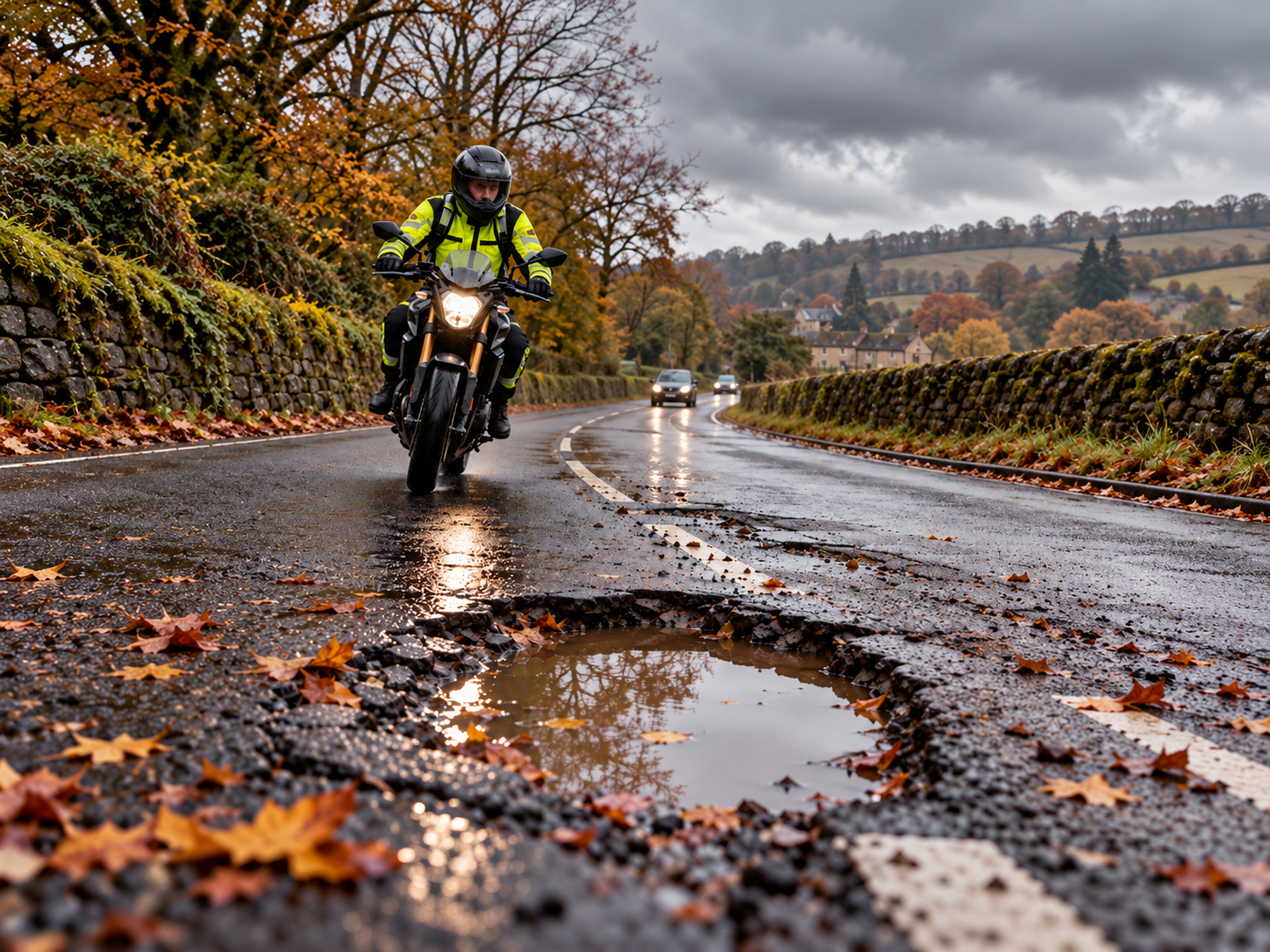
As riders, we know a pothole is far more than an uncomfortable bump.
After a summer of intense heat, many road surfaces are cracked, blistered and breaking up. Add autumn rain and those holes can quickly fill with water, hiding just how deep, and how sharp-edged, they really are.
Then, as temperatures begin to fall, frost can make things worse again by freezing water in the cracks and causing further damage.
For those of us on motorcycles, mopeds and scooters, that combination demands a little extra respect.
Recent RAC research shows just how widespread the problem has become. More than half of motorists say the condition of the roads is now their biggest motoring concern, while 83% say they encounter potholes on every journey.
Even more concerning for us as riders, 58% say they are having to take evasive action to avoid potholes.
For us, a sudden swerve can be every bit as hazardous as the pothole itself.
If we can’t safely avoid one…
Sometimes we spot a pothole too late and there simply isn’t a safe escape route.
Our instinct may be to grab the brakes, but heavy braking compresses the front suspension, leaving it with less travel to absorb the impact.
Instead:
- Ease off the brakes before impact.
- Keep the bike as straight as possible.
- Relax our grip and keep our elbows loose.
- Avoid locking our arms.
- If appropriate for the bike we’re riding, rise slightly from the seat and allow our legs to help absorb the impact.
Above all, we want the bike settled, balanced and travelling straight when it reaches the hole.
Better still: spot the danger earlier
The safest pothole is the one we have already seen.
Keeping our eyes up and scanning well ahead gives us more time to identify dark patches, broken surfaces, puddles and crumbling road edges before they become an emergency.
And those innocent-looking puddles? We should treat them with caution. None of us can tell how deep a water-filled pothole is until we are already in it.
Road position matters too. Where the surface is badly worn, the area close to the kerb can collect debris and often suffers more crumbling around the edges.
Giving ourselves the best possible view and choosing the safest available road position gives us more time — and more options.
Our bikes need to be ready too
Good maintenance really matters when the road surface gets rough.
Correct tyre pressures, good tread and properly maintained suspension help our bikes deal with bumps and broken surfaces far more effectively.
As riders, we can’t control the condition of every road we travel on.
We can, however, control how far ahead we look, the space we give ourselves and how well prepared both we, and our bikes, are for what lies ahead.